

Simon Higham’s 10 worst outboards of all time
10. Evinrude E-TEC
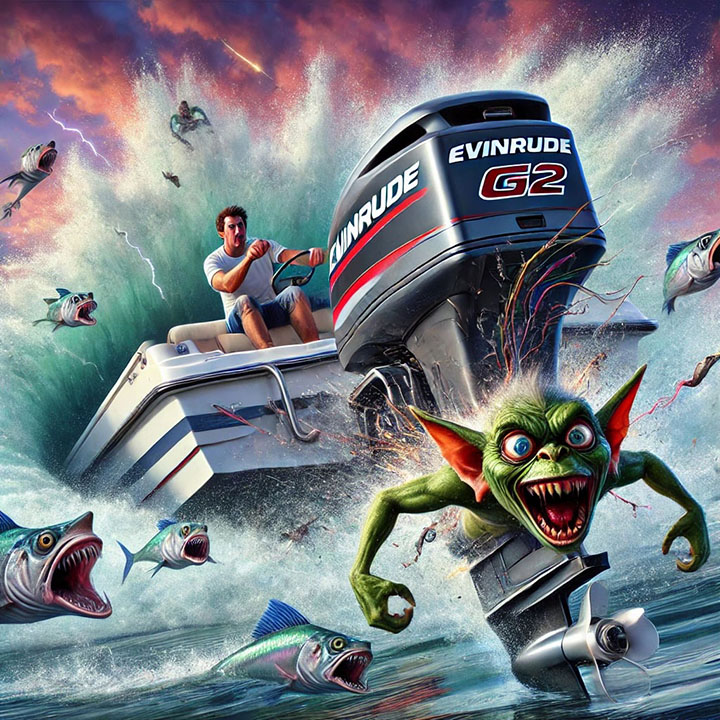
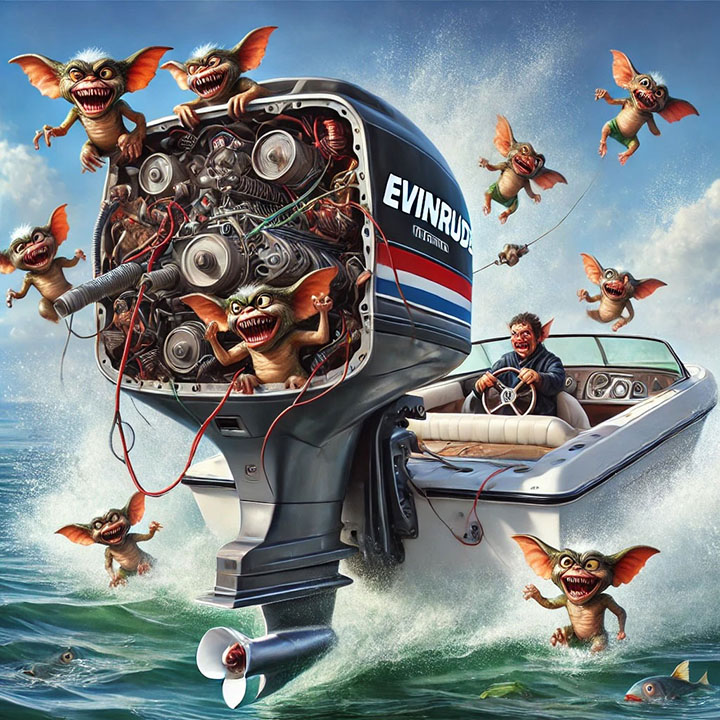
Let’s start with a bang—literally. The Evinrude E-TEC was known for its exploding lower cowlings. Not “falling off,” mind you—exploding. One second, it’s snug and secure; the next, it’s orbiting the Earth in a million pieces. You say plastic – i say weld – plastic? No
I needed to buy a cowling from ebay a few weeks ago for one of these and theyre so rare now that i had to pay £400 for one lower side cowl!
Next up – A water-cooled ECU with an integrated regulator/rectifier—because why not glue two separate sensitive electronic units together, pop them in a hostile marine environment and add salt water cooling for good measure? Its like they literally tried to make two intrinsically unreliable components half as reliable by putting them in one. And the price? 90hp etec ECU – £3000 – so if it fails the engine is scrap. Well done BRP.
Evinrude called it a technological marvel. Mechanics and owners called it a piece of shit.

9. Yamaha HPDI (High Pressure Direct Injection) or Highly Prone to Daily Issues
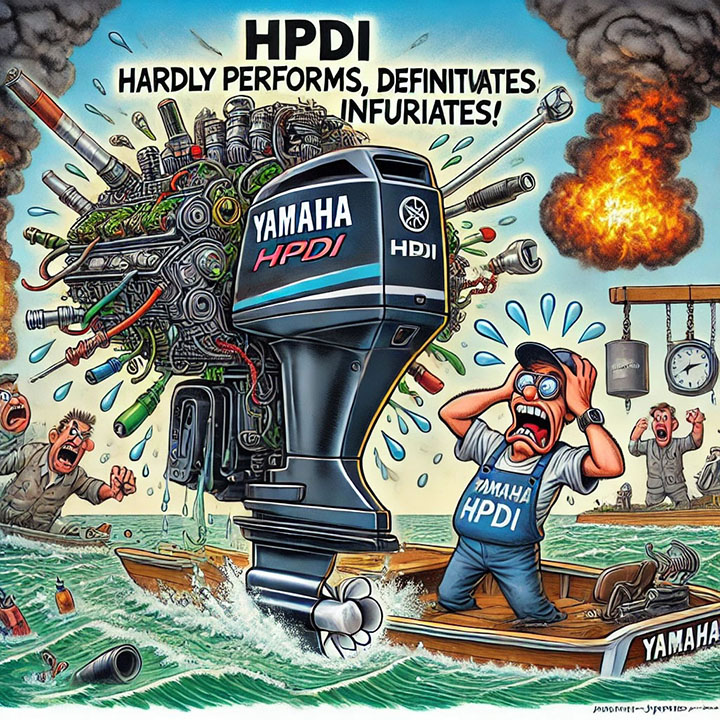
This engine was packed with high-pressure fuel pumps, injectors, and sensors galore—all of which could, and frequently did, fail.
Common faults? Where do we start? Injectors clogged up like a dodgy pub sink. The high-pressure fuel pumps loved to seize, and if you even walked a jerry can of E10 past one, the entire fuelling system would immediately melt in front of you. Oh, and let’s not forget the infamous oiling issues. Many an HPDI owner has had their exaltation of a rare faultless run out ruined as their engine decided it was done lubricating itself mid-journey.
But the real kicker? Trying to diagnose these issues without Yamaha’s proprietary tools was like trying to tickle a trout—possible, but infuriating. Mechanics either loved them (for all the work they brought in) or absolutely loathed them.
In short, the HPDI was the boat equivalent of a Ferrari: exciting when it worked, bankrupting you when it didn’t. If you’ve owned one, I salute you—you’ve earned a gold star for patience. This wasn’t just an outboard—it was a life lesson – and the lesson was don’t buy one.
8. Chrysler 105HP
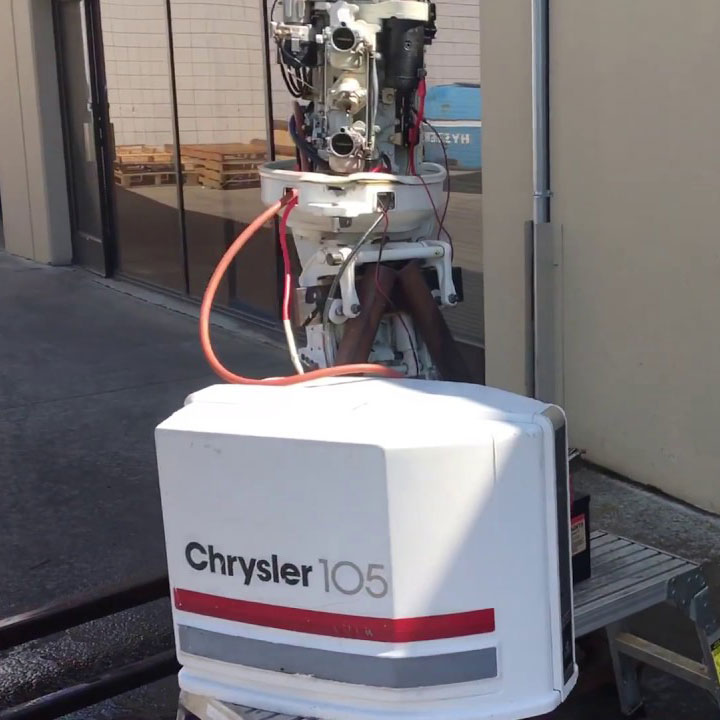
The Chrysler 105HP, or any 4 cylinder chrysler – and later force for that matter – it’s like that one uncle knobhead who always promises to sort his life out but never does.
This engine came with three standout features: an ignition system that didn’t like to do the ignition bit, a powerhead that seized up just because it felt like it, and powerhead bolts positioned by someone who clearly hated mechanics.
One of these big dopy bstaards seized on me whilst i was running it in directly after i’d rebuilt it. rrrrrrrrrrrrrrrrrrrrp. f’kin thing! My dad gave me a right bollocking, we stripped it down and miked it up – everything was perfect. The engine just decided that it was my turn to have a bad day.
And those powerhead bolts? You had to unscrew them with a spanner half a face at a time. It’s almost as if Chrysler had a grudge against outboard mechanics.
Sorry, Dad, I know you loved the old Chryslers, but this one wasn’t just bad—it was a crime against boat owners and boat mechanics alike.
7. Suzuki 55HP 3-Cylinder 2 stroke
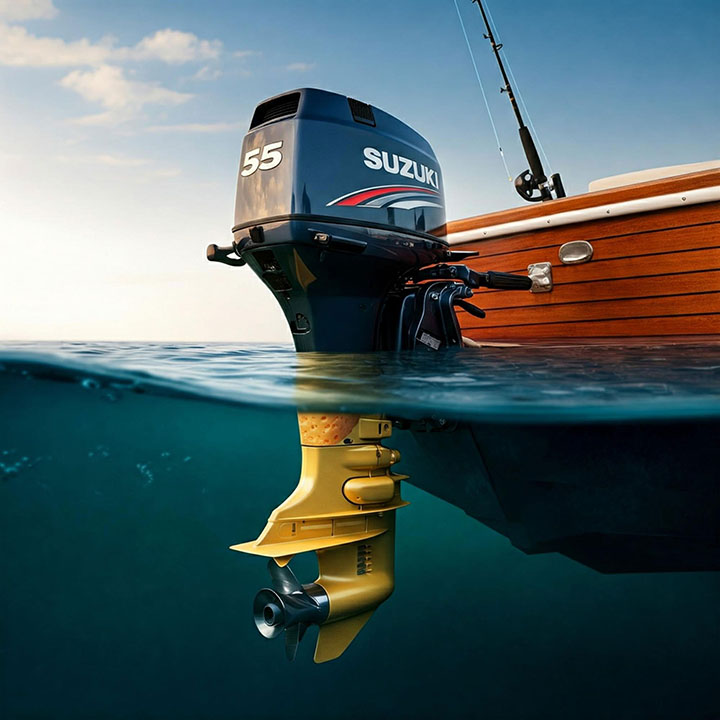
This gearbox so soft—it should have been born Gen Z. It took one look at a hard day’s graft and threw in the towel. Clutches? Gone. Gearsets? gone.
Our scrapyard was literally full of pristine-looking 55HP engines with missing bottom ends. I’ve never seen such an elegant collection of half-functional outboards all with the same fault.
And let’s not forget the throttle position sensor (TPS). It failed so often we started keeping spares just to save time. The worst part? It wasn’t even cheap to fix. Suzuki marketed it as “reliable.” I’m assuming that was shorthand for “reliably disappointing.”
6. Every Honda Outboard ever built (the alka-seltzer of the outboard world)
“Plink, plink, fizz.” That’s the sound of your Honda outboard dissolving into a frothy puddle of regret. Honda outboards are brilliantly engineered—ideal for commercial users who will put 3000 hours on them in three years then dump them on some poor unsuspecting leisure punter. The tragedy is that they often looked fine on the outside, giving them false hope. But then they over heat, or start to mix water and oil, take them apart, and there’s corrosion everywhere. Water jackets? Dissolving. Bolts – all seized. And when you finally get half the bolts out and snap the others, you take off the exhaust cover and you’re met with more white dust than there was on the office table in Scarface. If you’ve got one that’s survived more than ten years in saltwater, you’re either blessed or bullshitting.

5. Suzuki 25HP V-Twin 4-Stroke
There are ugly engines, and then there’s the Suzuki 25HP V-Twin — this monstrosity is so cumbersome, so ugly, and so utterly pointless, it’s almost impressive. Almost.
This thing was as heavy as a cement mixer with a full mix in it and it looked like it had been designed on the hangover after a particularly boozy suzuki office party – i can just picture the little japanese designer slumped at his desk feeling the pain from the night before.
Do the hand gestures and then rip up paper.
As for performance? Singularly uninspiring. Owners quickly discovered that it was more useful as ballast than propulsion – so if you’ve still got one, do yourself a favor and toss it in the skip or use it as your next mooring anchor.

4. Chrysler 65HP Twin Cylinder
This engine had all the finesse of a sledgehammer. Straight out of the box, it piston-slapped so badly you’d think it was auditioning for a drum solo. The exhaust ports were so large, there was barely any cylinder sleeve on the exhaust side. And honing? Forget about it. The ports were so poorly designed, even walking past the engine with a honing tool would wear them unevenly.
To be fair, when they worked (a rare event), they were fast. But that just made them even more heartbreaking when they inevitably broke down. In short – an engine for masochists, but it’s less painful whipping your nethers with stinging nettles than owning one – allegedly.

3. Evinrude Ficht Ram Injection (All Models)
Ah, the Ficht—a masterclass in how to turn a revolutionary idea into an absolute train wreck. On paper, the Ficht looked like the future of outboard technology. Direct fuel injection promised better performance, lower emissions, and improved fuel efficiency. Boaters thought they were buying cutting-edge engineering. What they actually got was a grenade with a propeller, primed to explode the moment you dared to start it.
Let’s begin with the injectors. These weren’t just unreliable—they were fragile, temperamental, and more expensive than your annual holiday. They clogged faster than a cheap pub drain and failed with such enthusiasm its like they were primed to self-destruct.
When they did go (and they always did), they tended to take the powerhead with them, leaving behind scorched pistons, scored bores, and very, very unhappy owners.
But wait, it gets better. The Ficht’s high-pressure injection system operated at up to 1,500 PSI, so the slightest impurity in the fuel could cause catastrophic detonation. That’s right: a tiny bit of muck in your fuel could send your pistons hurtling out the exhaust port like a budget fireworks display. And if you weren’t already crying, the repair bill would finish the job.
Now let’s talk cooling. Or rather, the lack of it. Ficht engines ran hot—really hot. Overheating was so common it should’ve been printed in the owner’s manual as a feature. This, of course, only made the injector and detonation issues worse, creating a perfect storm of failures that kept mechanics gainfully employed for years.
And the electronics. Oh boy. The Ficht’s ECU (Engine Control Unit) wasn’t just a brain; it was a temperamental diva. Prone to glitches, error codes, and complete meltdowns, the ECU was about as reliable as a weather forecast. On more than one occasion, we’d see engines that refused to start because the ECU had simply decided it didn’t feel like working that day.
Then there was the build quality. Let’s be generous and call it “questionable.” Fasteners corroded faster than you could replace them, and wiring harnesses were about as robust as wet spaghetti. You could practically see the water creeping into every connection, causing a cascade of shorts and failures that made owners seriously consider rowing as a viable alternative.
The real kicker, though, was the customer support. OMC’s warranty response was so bad it bordered on comedy. Owners would call in to report yet another engine failure, only to be met with excuses, delays, or outright denial. If you managed to get your engine repaired under warranty, you were one of the lucky ones. If not, you were left with a very expensive anchor and a burning hatred for Evinrude.
It’s no wonder the Ficht engines took down OMC. Between the warranty claims, lawsuits, and plummeting customer confidence, the company didn’t stand a chance. They might as well have renamed the engines FICHT: “Financially Impossible Catastrophic Headache Technology.”
The Ficht promised the moon but delivered a flaming wreck. It’s not just a bad engine—it’s a cautionary tale, a textbook example of how not to do direct injection. If you see one for sale today, do yourself a favor: keep walking. Or better yet, run.
2. Honda 75/90 Carb Models
Fixing the slow-running and acceleration under load fault on these was an experience in pure torment. To clean the jets, you had to drill out core plugs—core plugs that Honda didn’t even sell as spares. My dad came up with a genius workaround: drill a dmll hole in the core plug that you could screw a small self tapper into, pull out the plug, clean the jets, then slide a piece of solder wire into the drilling in the core plug and peen it flat thus sealing the hole, then pop the plugs back in place. It worked, but why should we have to a-team a fix for something that should have been simple? And most other outboard mechanics couldn’t be arsed with all the extra effort so there are thousands of scrappers around with duff carbs. Good news is if you need a powerhead or gearbox they’re ten a penny.
But the worst part? You’d hand it back to the customer, and a week later they’d ring you up: “It’s bubbling like a berocca in a glass of water.” Thanks, Honda.
1. Johnson 40HP RD-22
The Johnson 40HP RD-22 from the 1960’s – it wasn’t just bad—it was a full-scale assault on boating, boaters, and outboard mechanics. Starting it required a combination of prayers, curses, and the patience of a saint. They used to kick back so hard your carpal tunnels would fall out.
Tuning it? Oh, just a high-speed mixture screw, a low-speed mixture screw, timing advance more complicated than river dance, throttle advance, and whatever else it could throw at you. By the time you were done, you’d grown a beard, aged a decade and lost your will to live.

Next let’s talk about JOOG—Jumping Out Of Gear. It was so common, my dad had to invent an abbreviation for it. He even built a jig to grind back-cuts into the gears just to keep it in forward. That’s how bad it was.
If this engine were a person, it’d be the kind who steals your mooring space, syphons your petrol, and leers at your daughter. A despicable engine that thankfully is now a thing of the past.
That just leaves our dishonourable mention
The Evinrude G2 (aka G-Poo)
The G2 was supposed to be a revolution in outboard technology—a sleek, integrated system with futuristic features that would change boating forever. And it did, in a way. It changed how often you saw your mechanic, how many expletives you could string together, and how quickly you could empty your bank account.
Let’s start with the gearbox. Designed to handle big power and torque, it instead seemed to handle big stress about as well as a nervous apprentice on their first day. The clutch dog wore out faster than a cheap pair of shoes, leading to gears slipping and shredding themselves into metallic confetti. It wasn’t a case of “if” it failed but when, and when it did, the sight of oil filled with sparkling metal flakes was enough to make grown men cry.
Next up, the powerhead. This was the pièce de résistance of the G2’s failure parade. Evinrude’s high-pressure fuel injectors, running at an eye-watering 2,000 PSI, were prone to clogging if you didn’t keep your fuel as clean as a lab sample, causing a catastrophic lean burn detonation. The result? Holes punched through pistons, exhaust skirts cooked beyond recognition, and an engine that sounded like it had swallowed a handful of ball bearings. When a G2 went bang, it didn’t go quietly—it went out with a bang loud enough to alert the Coast Guard.
Then there was the steering system. Integrated hydraulic steering sounded great on paper, but in reality, it was the equivalent of supergluing your car’s steering column to the engine. When it worked, it was fine. But when it didn’t—which was far too often—you were left with a wheel that spun but did nothing. Leaks, pressure drops, and outright failure turned what should have been a relaxing day on the water into a full upper-body workout.
Now for the electrical system. The G2 featured a CAN bus network that was so temperamental, it felt like it was daring you to use it. Wiring harnesses and connectors, exposed to the harsh marine environment, corroded faster than a cheap tin of biscuits left in the rain. Water ingress caused shorts and threw up error codes that had even seasoned mechanics scratching their heads. You’d spend hours chasing electrical gremlins only to find that the solution involved replacing a part that cost more than your last holiday.
Let me tell you about a local RIB adventure company that ran a pair of these bad boys. It was like watching a slow-motion train wreck. Between gearbox implosions, blown powerheads, and endless downtime waiting for parts (which were about as easy to find as a polite argument on Facebook), their boat spent more time on land than water. Customers waited at the dock while the owners stared down the barrel of financial ruin. Let’s just say nobody ever ran these commercially without some kind of breakdown—mental, mechanical, or both.
Evinrude promised us the future with the G2, but what we got was a high-tech disaster that looked great on the back of your boat—provided you didn’t try to actually use it. Flashy, unreliable, and prone to catastrophic failure, it’s a dishonorable mention that’ll live in infamy. G2? More like G-Poo. These engines really are as much use as tits on a fish.
There you have it, folks: the top 10 outboards that made mechanics weep and boaters cry. Think I missed one? Got your own horror story? Let’s hear it in the comments—because misery loves company. Well what are you waiting for – get typing!